
Daoxin Dechen: Forging the "Most Powerful Brain" and Writing Its Cause into the Safe Journey of China's Railways
2026-11-18 Beijing DaXinDeChen Technology Co., Ltd.
From an office in Chaoyang, Beijing, to security screening lanes across railway stations and depots, Beijing Daoxin Dechen Technology Co., Ltd. has spent six years embedding itself into the security screening chain of China's railways.
Editor's Note: This article is reposted from the "Seeing New Private Enterprises" column of China Business Times, by reporter Ye Tao.
From an office in Chaoyang, Beijing, to security screening lanes across railway stations and depots; from lines of algorithm code to screens displaying real-time image judgments... Beijing Daoxin Dechen Technology Co., Ltd. (hereinafter referred to as "Daoxin Dechen") has spent six years embedding itself into the security screening chain of China's railways. Founded in 2020, this technology enterprise deeply engaged in artificial intelligence, computer vision, and information system integration has a very modest positioning for itself: to be a company that "can solve problems."
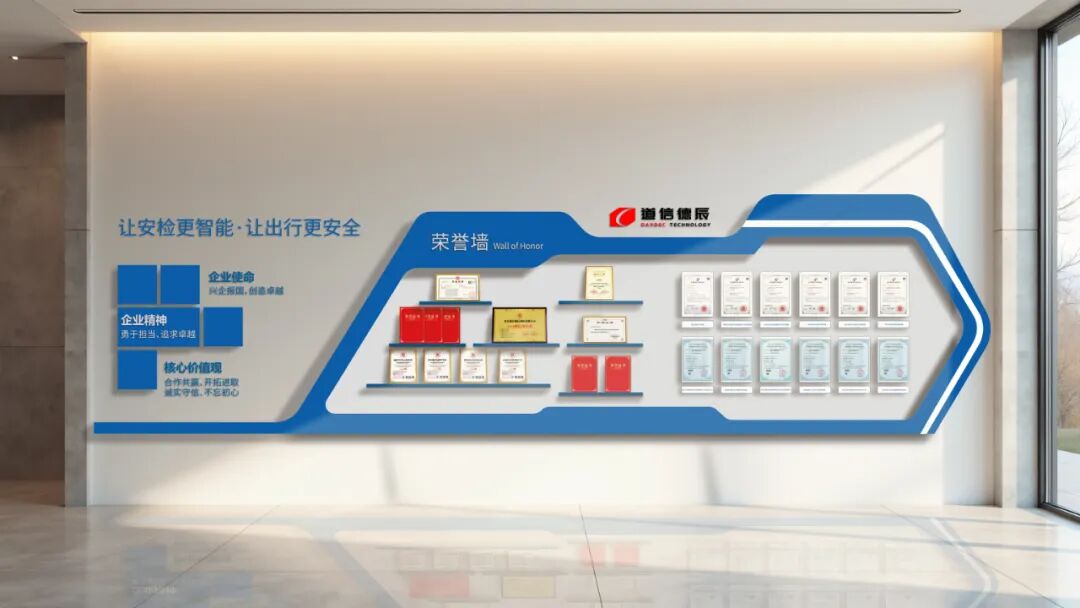
A wall of honors displaying various qualification certificates and multiple invention patents.
"Make security screening smarter, make travel safer." This sentence, written on the homepage of the company's official website, is the starting point and ultimate goal of all of Daoxin Dechen's business. From product development to standard formulation, from station and depot implementation to talent cultivation, a path of using technology to safeguard public safety is extending beneath the feet of this young enterprise.
Conducting R&D on the Front Line
Anyone who frequently takes trains has had this experience: long queues form in front of security checkpoints, security officers stare intently at X-ray machine screens, repeatedly saying "please turn around, please take out your phone, please open your bag"... In the view of the Daoxin Dechen team, the speed and accuracy of security screening directly affect every passenger's travel experience and their "safe journey."
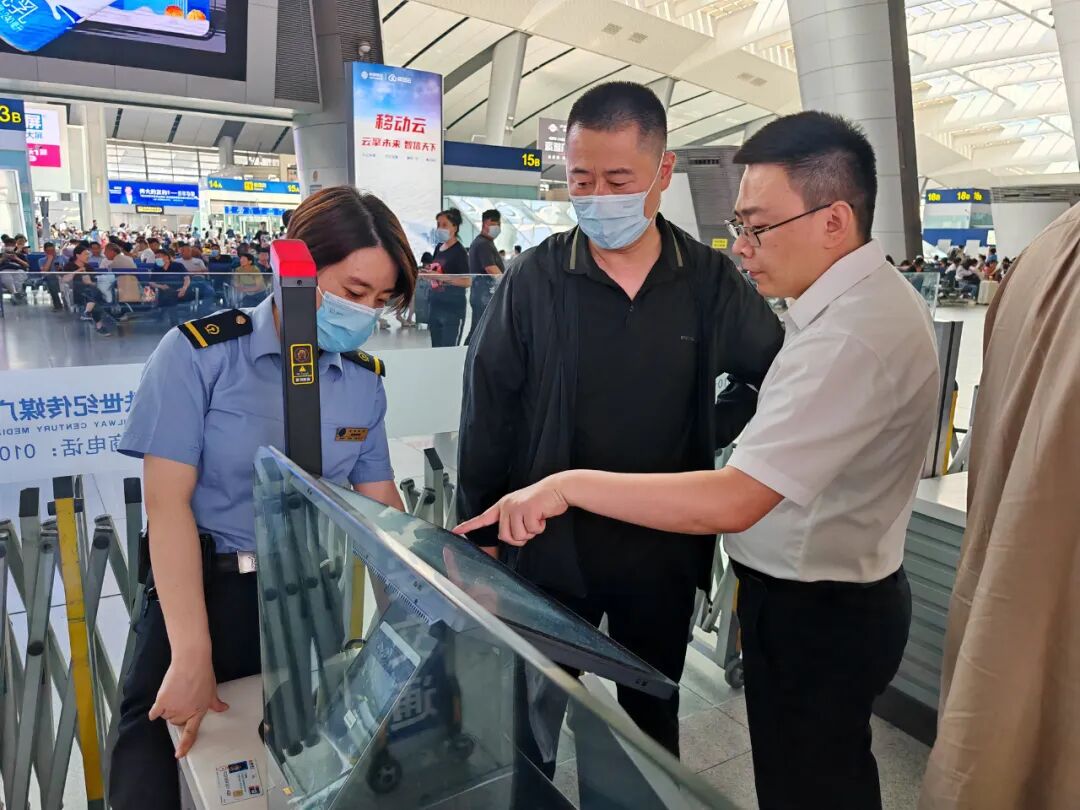
Introducing the use of the security screening handling management system to a railway client.
In the deep winter of 2019, the founding team of Daoxin Dechen went to a large railway station for research. At 4:30 in the morning, long queues had already formed outside the security screening lanes. Team members stood behind a middle-aged female security officer and watched her stare intently at the screen without relaxing for two hours. When handing over her shift, she rubbed her back and said: "If only the machine could share a little more of the burden for me." This simple remark was later written into Daoxin Dechen's first version of its requirements document—using technology to ease the burden on frontline security officers, making security screening more efficient and more humane.
In 2020, Daoxin Dechen was officially established, focusing on the vertical track of "smart railway security screening + AI public safety." At that time, domestic railway security screening had long relied on traditional equipment and manual experience, with serious data silos, weak intelligent analysis capabilities, and prominent efficiency bottlenecks. As China's railway operating mileage exceeded 160,000 kilometers and annual passenger volume surpassed 4 billion person-times, security screening was compelled to complete a fundamental leap from "human-wave tactics" to "smart security protection."
After its establishment, Daoxin Dechen did not rush to recruit sales staff or chase the market. Instead, it moved its office to the security checkpoint: going deep into multiple railway bureaus and passenger stations and depots across the country, living and eating alongside frontline security officers, and observing, recording, and analyzing every link in the security screening process on site. Hundreds of practical pain points and thousands of hours of on-site research ultimately settled into one R&D requirements list after another. "Our product managers must first learn to stand for eight hours in a security screening lane," said the company's R&D head.
It is precisely this persistence in "conducting R&D on the front line" that has given the products the label of "practical, effective, and easy to use" from the very beginning: the self-developed smart security screening integrated management platform can achieve full-chain digital and intelligent management of security screening data, truly integrating the three-defense system of personnel, physical objects, and technology; the AI intelligent image judgment system captures abnormal behavior and suspicious items in security screening lanes in real time, raising the recognition rate of suspicious items to over 98%...
Putting Products Through the "Sieve" in Real Scenarios
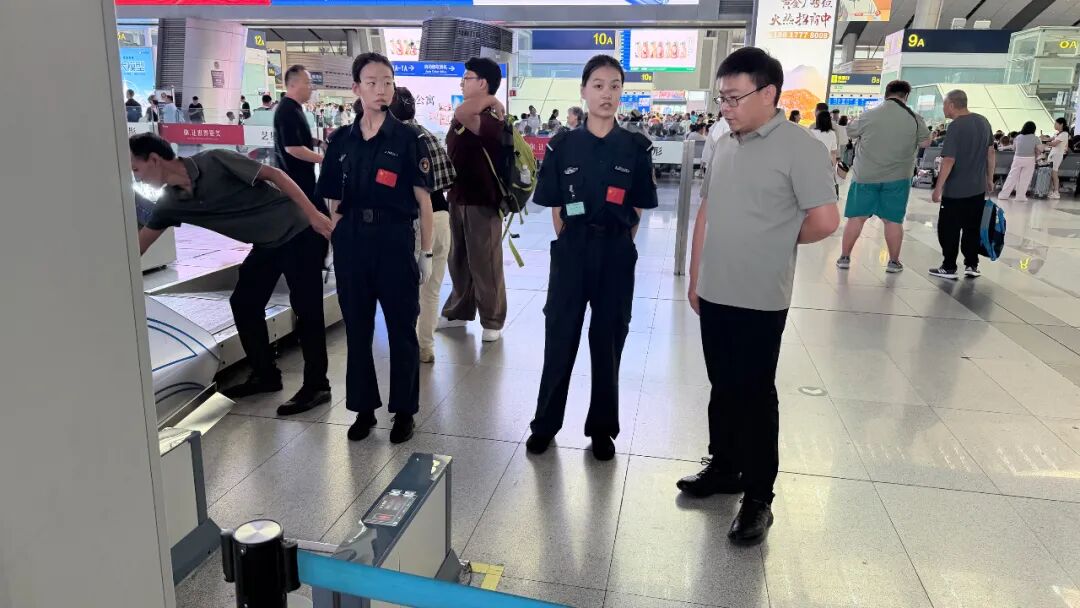
During the summer travel rush, company personnel conduct on-site research on the operation of security screening equipment at a railway station.
In Daoxin Dechen's product map, security screening is not just an isolated device but a complete chain: recognition, image judgment, handling, management, and training, all linked together. With AI algorithms at its core, the company has built a system of "6 major business scenarios + 1 digital management platform," providing the industry with a one-stop overall smart security screening solution.
The AI security screening intelligent image judgment system is called the "most powerful brain" of security screening equipment. It does not require replacing the entire machine; simply connecting a small analysis device to an existing X-ray security machine enables intelligent image recognition: parsing parcel images in real time, automatically marking 35 major categories of prohibited items such as firearms, controlled knives, fireworks and firecrackers, flammable and explosive liquids, and lithium batteries, with synchronized audio and visual warnings, and a special liquid detection rate of 98%. For a large number of existing lanes, this is a low-cost, non-destructive intelligent upgrade.
The centralized image judgment system has rewritten the model of "one image judge per lane": baggage images from the entire station are uniformly transmitted to the back-end image judgment room, and the system automatically dispatches orders according to seat availability. AI performs initial screening first, followed by manual review. During peak periods, multiple seats collaborate; during off-peak periods, input is reduced, cutting image judgment positions by more than 40%. The system also has fault emergency switching capability to ensure business continuity.
The simulation training platform replicates the scroll image output interface of real security screening machines 1:1, with a built-in X-ray image library of tens of millions of prohibited items covering 11 major categories of dangerous goods. It automatically identifies trainees' weaknesses in image recognition and pushes targeted exercises. In addition, it includes standardized exams, color blindness and weak color perception tests, and stress resistance assessments, automatically generating employee skill profiles, turning experience inheritance into quantifiable and replicable standard training.
Around on-site handling and management, Daoxin Dechen has also developed a bag-opening handling management system (re inspection station), turning the bag-opening inspection of suspicious luggage into an electronic closed loop of "image judgment - bag opening - handling - registration - traceability"; the smart duty management system enables intelligent scheduling, attendance monitoring, and performance accounting; and the risk emergency management system drives security screening from "post-incident handling" to "pre-incident warning."
Smart security screening has no laboratory answers, only on-site answers, and products need to be put through the "sieve" in real scenarios. Daoxin Dechen's products have almost all been forged in the major tests of the summer and spring travel rushes.
In 2024, intelligent image judgment equipment was delivered in batches to Lishui Station in Zhejiang, Tangshan Station in Hebei, and the Qinhuangdao Railway Station Depot in Hebei, operating stably during key summer transportation support. Systems such as centralized image judgment and bag-opening handling were successively implemented at stations, improving both passenger passage efficiency and image judgment quality simultaneously. Whether a product can be used depends not on demonstrations but on operation—this is Daoxin Dechen's hard requirement for every device.
"Security officers are the ones most qualified to say whether equipment is good or not," said the company's project head. After each delivery, the team stays at the station for a period of time to observe peak-hour queues, image judges' movements, and records of false and missed alarms, and then goes back to improve the product. It is precisely this approach of "delivery is not the end" that has earned Daoxin Dechen a reputation in the railway system and kept product iteration closely tied to the front line.
Writing the Answer of Serving the Country Through Technology in Standard Leadership and Product Iteration
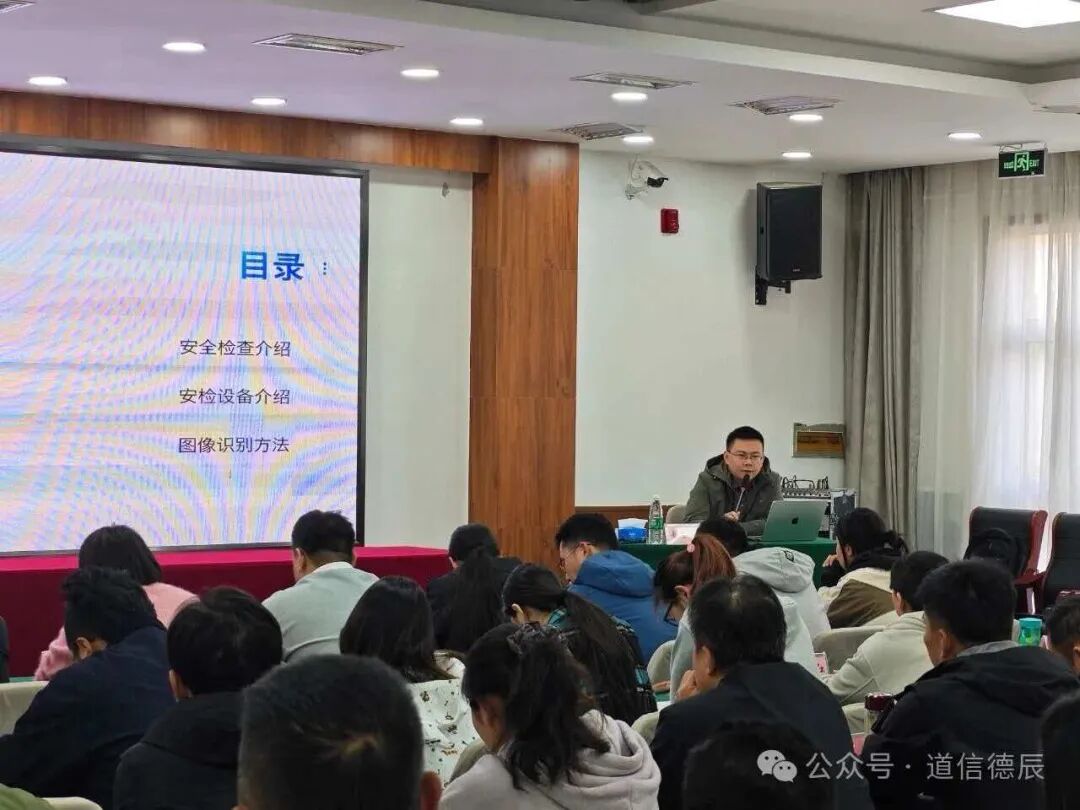
Company General Manager Zhao Jinlong teaching at the security screening business knowledge training class of China Railway Beijing Group Co., Ltd.
Railway security officer training has long faced difficulties such as inconsistent standards, scattered training resources, and difficulty in quantifying practical capabilities. Since 2019, the founding team of Daoxin Dechen has systematically studied this issue, traveling to major railway passenger stations and depots across the country, holding in-depth exchanges with hundreds of frontline security officers and management personnel, upgrading the "local methods" scattered across stations and depots into an industry standard system, and writing the answer of serving the country through technology in standard leadership and product iteration.
In 2024, the Railway Security Personnel Training Manual, edited by Daoxin Dechen, was published and distributed. From basic security screening knowledge to operational specifications, from equipment use to emergency response, this textbook builds a systematic and standardized content system, providing an industry-level operational specification reference for railway security screening work.
On the technical side, Daoxin Dechen has established industry-academia-research cooperation relationships with railway research institutes, carrying out joint R&D in areas such as intelligent video analysis and AI algorithms, and transforming cutting-edge research results into practical technologies usable at security screening sites. The company's core team has more than 10 years of deep industry experience and has established deep cooperative relationships with railway bureaus under China State Railway Group, subway operating companies, and civil aviation airports.
On the training side, the company has brought classrooms into railway bureaus. In recent years, the company has cumulatively taught at 18 railway bureaus across the country, training over a thousand trainees; it participates throughout the process from course design to practical assessment, with all course content drawn from real frontline cases and combining theoretical instruction with practical drills, receiving unanimous praise from trainees.
Supporting all of this is sustained R&D investment and a systematic innovation mechanism. Daoxin Dechen has established a sound R&D management system and patent layout. Since 2020, it has intensively applied for patents around core technologies such as facial feature recognition and X-ray image recognition, and multiple utility model patents and software copyrights have been authorized successively, forming a moat of proprietary technology; multiple core technologies have achieved industrial application, serving fields such as railways, subways, and civil aviation.
Behind innovation is a emphasis on talent. "A small enterprise must be refined. Science and technology SMEs must pursue 'one worker with multiple skills, one person with multiple uses,'" admitted Zhao Jinlong, the company's founder and general manager. The company implements "job rotation training + technical complementarity": R&D personnel must go to the front line to understand the actual scenarios of security screening operations, and marketing personnel must be able to understand the logic of core technologies; the weekly technology sharing session is a "required action," regardless of rank or position—whoever has an idea takes the stage to speak.
For young talent, the company values room for growth even more. "The company does not care what level a person is at when they join, but cares about how high they can grow here," Zhao Jinlong said.
"Reverent in Affairs and Trustworthy" Interprets the Foundation of Corporate Culture
The Analects says: To govern a state of a thousand chariots, be reverent in affairs and trustworthy; govern with virtue, like the North Star. This saying has been written into Daoxin Dechen's corporate culture, from which the corporate values of win-win cooperation, pioneering and enterprising, honesty and trustworthiness, and not forgetting the original aspiration have been distilled. In Daoxin Dechen's view, security screening is a "work of conscience," and an enterprise must first be a "trustworthy" company.
Zhao Jinlong graduated from the Communication University of China with a major in digital media art and holds a Bachelor of Arts degree. He has long been committed to research in fields such as macroeconomics, artificial intelligence, and transportation, and holds more than 20 invention patents and more than 40 utility model patents. He has served for consecutive years as a specially appointed lecturer for China State Railway Group and China Railway Beijing Group. The country's first railway real-name verification gate machine, which he participated in designing, has now become an industry standard for railways and has received widespread media attention and coverage. He has been appointed as a senior think tank expert of the National Joint Integrity Service Platform and a senior think tank expert in macroeconomics of the Yuanpei Expert Talent Database. He also serves in social positions such as director of the Entrepreneur Fellowship of the Beijing Municipal Committee of the Revolutionary Committee of the Chinese Kuomintang and deputy director of the Economic Special Committee of the Chaoyang District Committee of the Revolutionary Committee of the Chinese Kuomintang. Regardless of the position he holds, being conscientious, responsible, and keeping his word has always been his true character.
At the end of the interview, a line of writing remained on the whiteboard in the company's meeting room: "Next-generation centralized image judgment, compress response by another 200 milliseconds." Outside the window, city buildings stood quietly in the afternoon sunlight; in stations hundreds of kilometers away, trains were passing through security screening lanes, and the algorithms on the other side of the screens were examining frame by frame.
There are no earth-shaking grand words, only solid iteration. Perhaps this is how a young technology enterprise grows—putting technology into scenarios, putting responsibility into products, and writing its cause into the safe journey of China's railways.
Source: China Business Times (Reporter Ye Tao) Original title: Daoxin Dechen: Forging the "Most Powerful Brain" and Writing Its Cause into the Safe Journey of China's Railways
Want to learn more about DaXinDeChen products and services?
Contact Us →